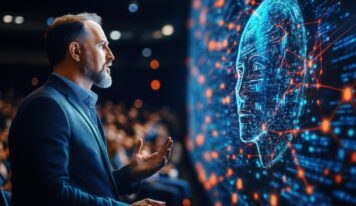


For decades, the traditional image of a successful company was simple: a large office, hundreds or thousands of employees, different departments, managers, and a clear hierarchy. But artificial intelligence is challenging this model. What if one person with a laptop and a team of AI agents could do the work that once required an entire company?
Dario Amodei, co-founder and CEO of Anthropic, was asked when we might see the first billion-dollar company with just one human employee. His answer was simple: “2026.” His prediction suggests that AI could make it possible for a single entrepreneur to manage areas such as programming, marketing, research and customer service with the help of AI systems.
The idea may sound extreme, but the technology is already changing how small businesses operate. Sara Russell, founder of Mainland Vintage Bath & Body Boutique, uses AI almost like a virtual management team. She relies on it for marketing, finance, product development and sales strategy, while keeping the creative decisions herself. In her words and experience, AI does not replace the founder — it allows one person to operate more like an entire organization.


Sam Altman has also imagined a future where individuals have their own virtual experts. He said: “Eventually, we can each have a personal AI team full of virtual experts in different areas working together to create almost anything we can imagine.”
If that future arrives, the meaning of the word “company” could change completely. A company may no longer need dozens of employees sitting in different departments. Instead, it could be one person making the important decisions, while AI handles much of the repetitive or specialized work.
Jensen Huang, CEO of NVIDIA, described a similar transformation from another perspective. He wrote that AI will evolve “from tools to teammates” and eventually become a kind of “digital workforce of companies.”
But bigger does not automatically mean better — and smaller does not automatically mean easier. Recent reporting on AI startups shows that tiny teams can become extremely productive, but founders can also end up working longer hours because AI agents require constant supervision and coordination.

So, do businesses still need large companies?
Probably yes. Large organizations have advantages that AI cannot simply erase: huge networks, capital, infrastructure, specialized knowledge and the ability to manage complex projects at a global scale. But AI may change how many people are needed to create that scale.
The future may not belong exclusively to corporations or to teams of five people. Instead, we may see a new kind of company: small at its core, but enormous in its capabilities.
The most important question is no longer “How many people work for this company?”

It may soon become:
“How much can one person accomplish with the right technology?”
Read the article: Your Own Boss — Your Own Prisoner?